
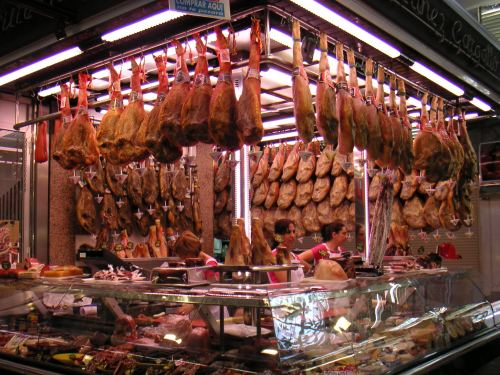
I have been living in Spain now for almost 6 years, and I have always found Spaniard’s blind devotion to jamón (cured pigs legs) to be rather curious. You often witness Spaniards declare “no hay nada como un jamón” (there is nothing like jamón). Every time I hear someone make such a sweeping statement of idolotry for the flesh of a pig’s leg, I think these people have most likely had one slice too many (hence, the extremely low birth rate in Spain). I can easily think of a dozen things in life that are more valuable to me than deli meat or food in general. And over time, I have even grown to abhore dried pork legs. Having said this, I also must admit that for the past 6 months I have actually begun having my first cravings for jamón.
But my personal relationship to jamón is not at issue in this post. Rather this post explores what I suspect to be an unknown conspiracy behind the Spanish delicacy. I have brought it up on numerous occassions in the past few days at work, and no one (with the sole exception of Martha who happens to be from Colombia, not Spain) seems to be concerned . That in and of itself concerns me. Why doesn’t anyone want to question the obvious? What are they trying to hide? Please permit me to explain . . .
In the movie, the English Patient, Caravaggio says that in Africa there are always chickens but no eggs, and in Italy there are eggs but no chickens. Similarly, in Spain there is jamón everywhere but no pigs. It is astonishing! You go to any bar, all of the large super markets, delis, or any other place where food is sold, and you encounter rows and rows of hanging pig legs. And yet when you travel accross Spain, you almost never see a single pig. The numbers simply do not add up.
Let’s analyze this. Jamón, at least the good stuff, comes from Andalucía and Extremadura. You can also get lesser quality jamón in other regions of Spain. There are a couple of questions we need to ask. What is the shelf life of each leg of ham? How many pigs (specifically raised for the purpose of using their legs for jamón) are there in Spain? What is the annual birth rate of these pigs? How old are these pigs when they are ready to be reduced to jamón? Now, only the two hind legs are used for jamón. The front ones are not. That means that two legs equal one pig. So how many legs of ham are in the market at any given time? Then divide that number by two. I insist that there is an extremely disturbing number of ham legs hanging in Spain. So, do the numbers add up?
Personally, I am not so concerned about Spaniards lack of concern for the fact that so many pigs are sacrificed for the pleasure of consumption. Spaniards use the entire pig. They eat the ears, the heart, even pig souls. Spaniards also cook baby pigs in their old wooden ovens. These little guys are called cochinillos. Shove the entire little creatures in the oven, and you get a fantastic lunch. In Mallorca, they eat frit. This is where you take everything left over from your little pig — its blood, heart, and guts — and fry it all up with potatoes. Now that’s really tastey.
From a moral standpoint, I think that the Spaniards have it right when it comes to the pigs. The more you can eat from the taking of a sinlge life the better. If you killed the pig for just its legs, then you’d have a problem. Nevertheless, the numbers still don’t add up. Remember, only special pigs are used for jamón. Not all pigs. My guess is that either (i) Spaniards are secretly importing pigs to fill in the gap between consumption and production, or (ii) that they have genetically engineered a pig that can regenerate its hind legs. Yes, like lizards who re-grow their tails when cut off, I imagine clandestine pig wards in Extremaduran and Andalucian veterinarian hospitals full of pigs in wheelchairs waiting for their legs to grow back. These poor Sisyphus-like piggies have their legs cut off, just to grow back and then to be cut off again. La vida no es perra sino cerda . . .


Energizer Bunny tells me that there are plenty of pigs imported for the lower quality stuff.
Ninja tells me how well treated the pigs are on her family’s farm in Extremadura.
Natalia wants to introduce me to jamón producers.
Everyone in general thinks I have lost it.
Personally, I feel like there is a lot of denial out there.
This is the way special quality pigs are bred in Jabugo: http://static.flickr.com/43/102084553_99c01fe1bf.jpg?v=0
This is how normal or low quality are raised:
http://static.flickr.com/22/38663832_f16d93015e.jpg?v=0
And this is how the best ones are considered:
http://static.flickr.com/27/41477377_cf9f8c6b55.jpg?v=0
Hence you don’t see them when you drive across Spain: they are either in very rural (no highways) areas in the first case and in closed farms in the second…
Two more questions:
1. Can anyone tell me whether there has been a significant increase in the number of wheel chairs and/or crutches manufacturer in Spain or imported?
2. Has anyone seen the documentary when good pigs turn bad? The uncontrollable demand for jamón (and black market science) could turn this all into a science fiction nightmare.
And 2 questions more to add:
3. Are these wheelchairs subsidized by the State?
4. Do we have to pay an extra fee to Seguridad Social?
Anyway, thanks for your reflexions, I will use them for a science fiction script.
With the PSOE, you can surely count on it.
to make this a social issue: check out this short video:
http://www.themeatrix.com/
Pingback: Grave Error » Jamón part II: An alternative version
Pingback: Grave Error » Jamón part III: The sage continues
Dear Professor Napoli,
I understand your concern so the next time we are in Spain, I’ll drive you around la sierra de Huelva (Jabugo and surroundings) and you’ll see many many pigs, chubby and dark, yum!
Well, you can even see some when going to the beach in Menorca!
Also wanted to add that the 4 legs are used for jamon, the front ones are “paletillas”.Yum again!
Like they say in mi tierra: “del cerdo, hasta los andares”…
Jamón Goddess,
With all due respect, I think you are missing the point. I know there are pigs in Spain. The question is how many. It is realy a question of numbers and turn over. Are there enough pigs to supply so many legs of ham and is the pig birth great enough to sustain the demand for jamón?
Pingback: Grave Error » Jamón Part IV: An Alternative Explanation
Maybe Spaniards just use the rest of the pig to prepare “cocido” and “callos”…In spring/summer time they must export all these leftovers to the Southern hemisphere. It is actually the only explanation I can think of!
Thanks, Arantxa, but the question is NOT what they do with the rest of pig, but where are all of the pigs! Of course, I know that there are plenty of pig legs around, but where are the pigs that they came from, or the new pigs where they will come from?