literature


books-2011.jpg

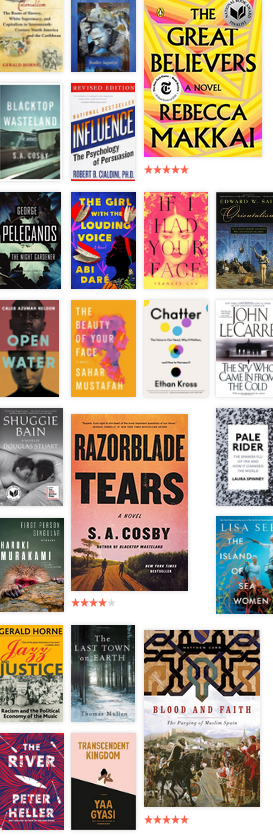
While I thought that getting any reading done during my first year of parenthood would be close to impossible, I have actually been able to take advantage of my commute to and from work and my son’s nap time on weekends to get quite a decent amount of reading done.

So in the end, 2011 has been a pretty good year for reading after all, more so considering that some of my favorite contemporary authors published new books this year. Here is what I have read in 2011:

Of course with the trial and tribulations of parenthood (and a day job as an attorney), I do not have the time to write a review of each of these, though I do wish I could. Nevertheless, let it be said that I would recommend all of them.

hard-to-find-the-time.JPG

Now after little over three months of being a father, I would think that what I missed the most from my pre-parenthood days would be alone-time and sleep.  But actually what I miss the most are (in no particular order):

  • Writing
  • Reading
  • Jazz

In a sense, I have learned to compensate for each. For example, instead of writing in Grave Error, I have followed the Twitter trend (btw, follow me) . Just as “video killed the radio star”, Twitter has killed blogging (which previously killed journalism). Now I tweet what I used to blog, just in a dozen words.

While I no longer have any justifiable excuse to lay in bed and read a book (or the news for that matter) instead of sharing the parental responsibilities of an infant, I have learned to do all of my reading almost entirely on my metro commute to and from work, at the expense of listening to podcasts. Surprisingly for only a 30 minute commute, in just three months, I have already finished Jonathan Frazen’s Freedom, Ryu Murakami’s 69, Colm Toibin’s Brooklyn, and believe it or not, Tolstoy’s War and Peace! And I am about to finish Rafael Yglesia’s A Happy Marriage. Not bad. Meanwhile, my consumption of other written media has been relegated to merely previewing what others post on Twitter.

Finally, with regards to Jazz, unfortunately, my baby’s ears are simply not ready yet for the angular sounds of Coltrane, Monk and Dolphy. Nonetheless, with his confusing daily exposure to Arabic, English, French and Spanish along with his multiple nationalities, I am forcefeeding my boy healthy doses of that other great and uniquely American, American music genre: Motown and old school R&B. He gets lots of Diana Ross and the Supremes, Smokey Robinson, Stevie Wonder, Curtis Mayfield, and others. His favorite songs, I have decided, are “People Get Ready”, “Me and Mrs. Jones”, and “Where Did Our Love Go”. Almost every Motown song that exists seems to have the word “baby” in the lyrics, making singing them to him appropriate at almost any time.

But regardless of those three sacrifices, I more than delighted with the lack of mobility that parenthood has forced on mommy and daddy — meaning no more weekend commutes to and from Paris. And, of course, there is my favorite substitute past time — when not changing diapers and soothing a crying baby — seen in the photo above (though now at three months he barely fits anymore).

books.jpg

These book vending machines are a nice alternative to the ones that just sell junk food. I have no idea whether they actually make many sales. This one is at the Principe Pio train station in Madrid. There are also a bunch of small libraries in a few of the Madrid metro stations where people can check out books for the commute.

new-adds.jpg

I have recently finished reading The Sultan’s Shadow: One Family’s Rule at the Crossroads of East and West by Christiane Bird and Geoff Dyer’s ode to Jazz, But Beautiful. The Sultan’s Shadow was slow at the beginning, often with great emphasis placed on things that had little interest to me (like the details of the Sultan’s palaces in Zanzibar), but overall was a compelling read about a time and place in history that I know almost nothing about: Eighteen Century Zanzibar and East Africa, Omani control over the region and the entrance of European Colonialism, the East African slave and ivory trades, and the British fascination with locating the source of the Nile.

But Beautiful was more of a mix bag. At times, I felt that Dyer was simply trying too hard or that his fictionalized vignettes of the historic accounts of famous Jazz musicians did not always add to a greater understanding of musicians or their craft. For example, the story related to Thelonious Monk reads identical to the Straight No Chaser documentary. On the other hand, I thoroughly enjoyed the portrayals of the Lester Young and Charles Mingus. If there was an overall theme it was that the the underlying tragedy of the Jazz musician — beyond even that of racial oppression — was addiction, vitally affecting each character and, instead of enhancing their performance, ultimately inhibiting it (maybe with the sole exception of Mingus whose addiction and principle personality trait was to devour everything in his path). Finally, although I did not particularly enjoy the piece on Chet Baker (mainly influenced by the haunting Let’s Get Lost documentary), I found Dyer’s analysis of Baker’s aesthetic as a sign of his inability to express either beauty or compassion as quite interesting.

And now – due mainly to the fact that for a number of personal reasons I am in a rush to read as much as possible by the end of the year – I have continued to add new books to my list. Like an insensitive ex, I have shamelessly moved on. I have already started David Mitchell’s new The Thousand Autumns of Jacob Zoet, about the Dutch trading post at Dejima, Japan at the turn of the 18th and 19th centuries. As always with Mitchell, the beginning is slow as I adjust to whatever vernacular he has created for his story, and then it picks up very quickly. New on my roster are:

These, of course, fighting on deck with the books I have yet to get to from the previous lists.

beautysummerhope.jpg

During the last two weeks (and after abandoned the dreadfully monotonous Desert), I have dug into my roster of books by finishing Zadie Smith’s On Beauty, Coetzee’s Summertime, and Laila Lalami’s Hope and Other Dangerous Pursuits. I enjoyed them in the reverse order. Here are my brief thoughts: (more…)

I am re-posting this most remarkable poem entitled “Revenge” by Taha Muhammad Ali:

Revenge

At times … I wish
I could meet in a duel
the man who killed my father
and razed our home,
expelling me
into
a narrow country.
And if he killed me,
I’d rest at last,
and if I were ready—
I would take my revenge!

*

But if it came to light,
when my rival appeared,
that he had a mother
waiting for him,
or a father who’d put
his right hand over
the heart’s place in his chest
whenever his son was late
even by just a quarter-hour
for a meeting they’d set—
then I would not kill him,
even if I could.

*

Likewise … I
would not murder him
if it were soon made clear
that he had a brother or sisters
who loved him and constantly longed to see him.
Or if he had a wife to greet him
and children who
couldn’t bear his absence
and whom his gifts would thrill.
Or if he had
friends or companions,
neighbors he knew
or allies from prison
or a hospital room,
or classmates from his school …
asking about him
and sending him regards.

*

But if he turned
out to be on his own—
cut off like a branch from a tree—
without a mother or father,
with neither a brother nor sister,
wifeless, without a child,
and without kin or neighbors or friends,
colleagues or companions,
then I’d add not a thing to his pain
within that aloneness—
not the torment of death,
and not the sorrow of passing away.
Instead I’d be content
to ignore him when I passed him by
on the street—as I
convinced myself
that paying him no attention
in itself was a kind of revenge.

Nazareth
April 15, 2006
Poem copyright 2006 by Taha Muhammad Ali. English translation and copyright 2006 by Peter Cole, Yahya Hijazi, and Gabriel Levin.

fact-fiction.jpg

During the first half of 2009, I was very lucky with my choice of books. Then during the second, for a number of reasons, I had less time to dedicate to reading. After finishing Jonathan Franzen’s The Corrections over New Years (which makes you wonder why Elizabeth Strout even bothered with Olive Kitteridge), I compiled for 2010 a roster of books that included both fiction and non-fiction:

Of what I have gotten to so far – from Random Family to Desert – the non-fiction (Random Family, Hope in the Unseen and Thelonious Monk) have stolen the show. The first half of Poisonwood Bible was excellent, while the second half seemed to lose credibility. Nevertheless, it did spark my interest in reading King Leopold’s Ghost. And regardless of having thoroughly disliked all of the characters in Geoff Dyer’s Paris Trance (which I read in 2009), the Monk biography has only made me want to read more non-fiction about Jazz, including Dyer’s But Beautiful: A Book about Jazz.

american-original.jpg

For most of 2009, I was a very good boy. Instead of buying new music, I did my best to recycle from the fairly vast collection that I already had – because, of course, the more music you have, the less of it you can enjoy.

And then my frugal trend suddenly took a turn for the worse. Over the last few days, I have been totally engrossed in Robin D.G. Kelly’s new book, Thelonious Monk: The Life and Times of an American Original. What a fantastic read, especially if you are a Jazz fan. The problem is that the book inspired me to fill in some of the gaps in my Monk collection, picking up

Revisiting some already in my collection, particulary,

And also getting my hands on a few rare gems by other Monk contemporaries:

  • Cootie Williams: 1941-1944 (with some of the first ever recordings of Monk compositions “Fly Right (Epistophy)” and “Round Midnight”, and with Bud Powell on piano).
  • Sahib Shihab: Jazz Sahib (with Bill Evans on piano)
  • Abbey Lincoln: Straight Ahead (with Coleman Hawkins, Eric Dolphy, Booker Little, Mal Waldron, and Max Roach)
  • Pepper Adams: 10 to 4 at the Five Spot (with Donald Bird, Doug Watkins, Elvin Jones, and Bobby Timmons).

Some critics of Kelly’s work complain about inclusion of African American-centric political commentary, of which I assume they mean references to slavery and the racial violence and discrimination that occurred during Monk’s life. But it would be hard to tell the story of a Twentieth Century African American – one whose great-grandparents and grandparents had been born into slavery and, like his fellow black Jazz contemporaries had difficulty traveling freely in certain states and were often harassed by the police – and not recognize that these factors essentially shaped their lives. Ignoring them is a denial of the American experience.

In any event, the book is thoroughly enjoyable and sheds light on Monk as a family man and homebody, a generous teacher – and not the eccentric hermit he was made out to be – but someone fully focused, dedicated and unwavering in the pursuit of his own unadulterated artistic identity. Monk never changed his style, not when he was being laughed at, not when he finally achieved recognition twenty years later, and certainly not thereafter.

nocturnes.jpg

I finally got back in the saddle again and this week finished three long-awaited books: Olive Kitteridge by Elizabeth Stout, Rhyming Life and Death by Amos Oz, and Nocturnes by Kazuo Ishiguro.

I have mixed feelings about Olive Kitteridge, this year’s Pulitzer Prize winning novel that just didn’t quite reach the same level as 2008’s The Wondrous Life of Oscar Wao. Throughout the book, I waivered between finding the writing style and structure (almost a compendium of short stories tied together by the ever present Olive Kitteridge) compelling to wishing that I was reading a ligher and more uplifting John Irving novel (Olive Kitteridge takes place in Maine and New England is the principle setting in Irving’s fiction). I was also reminded, believe it or not, of V.S. Naipaul whose protagonists, in particular Mr. Biswas, are often unlikeable characters, just as we are not always sure whether to root for Olive Kitteridge. Overall, though, while I recognize the writing talent and effectiveness of the story’s underlying theme – the inevitable loneliness of life, even in a picture perfect All American town – I suppose that I just don’t want to relate to such bleakness at this moment in my own life.

I am a big fan of Israeli writer Amos Oz’s works; I especially loved The Black Box. But with regards to his new novel, Rhyming Life and Death, I am really not sure what to say. Billed as reflecting “on writing, reading, middle age and the elusive chimera of literary posterity”, this meta-novella about a few hours in the day of a writer and his public left me almost completely indifferent. Just like with recent works by Coetzee focused on middle age and aging, Oz showcases his great ease with storytelling, but that’s about it. Nothing too memorable.

Finally, the book I thought I would enjoy the least, Ishiguro’s Nocturnes, I finished in just one sitting. Nocturnes’ five short stories all have a common thread – “love, music and the passing of time” – and unlike his other novels that are darker and more enigmatic, these stories were light and playful.  Usually when I finish an Ishiguro novel, with the exception of Remains of the Day and the heart-wrenching Never Let Me Go, I always feel slightly disappointed, possibly because his books have such great and promising titles: A Pale View of the Hills, An Artist of the Floating World, Remains of the Day, The Unconsoled, When We Were Orphans, Never Let Me Go, and now Nocturnes. I would love to be able to write novels with those names! Nocturnes, definitely not a magnum opus, at least left me wanting more, and definitely made up for me having to suffer The Unconsoled, possibly the most frustrating novel I have ever read (other than Celine’s Journey to the End of the Night which I quit after re-reading the first page ten times).

man-without-qualities.jpg

In the summer, the Leonard Lopate Show runs an ongoing series of interviews about underappreciated works of literature. Last year, thanks to the Underappreciated episodes, I discovered the Tea in the Harem by Medhi Charef and Season of Migration to the North by Tayeb Salih.  A few days ago, Lopate was discussing the mammoth, unfinished (both by myself and the author) The Man Without Qualities by Robert Musil. I attempted to read this book a few years ago while on the beach in Fuerteventura, only to abandon it, slightly intimidated after 80 pages, for V.S. Naipaul’s much shorter A Bend in the River. Hopefully one day I will find my way back to The Man.

Promising works from this summer’s list include the short stories of Egyptian writer Yusuf Idris, the Slovenian novel Alamut by Vladimir Bartol, Andrei Bely’s Petersburg, and Paul von Heyse’s Children of the World, A Novel. In the past, Lopate has also featured one of my all time favorite works of Japanese fiction, The Makioka Sisters by Junichiro Tanizaki.

Next Page »