
This morning I was listening to veteran New Yorker investigative reporter, Seymour Hersh, on NPR’s Fresh Air, and Hersh addressed a leaked story that
President Obama has rejected the options for Afghanistan presented by his national security team, and instead is pushing for revisions to clarify how and when U.S. troops would turn over responsibility to the Afghan government. This follows leaked classified cables from Americas ambassador to Afghanistan, Karl Eikenberry, expressing his misgivings about sending in more troops.
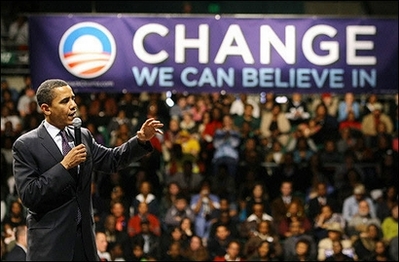
I have been very critical of Obama – even after strongly advocating for his election – for his bold words and tepid actions that have done little more than institutionalize the status quo. Instead of change, we’ve seen more of the same. On the Afghanistan, Guantanamo, torture and use of the military, I have also slammed Obama for thinking strictly in political rather than policy terms – a trait characteristic of Democrats to feign military toughness.
I suppose what has bothered me the most about the Obama presidency is not that Obama has gone back on his campaign promises – that is what all politicians do – but that I know Obama knows better. I think he understands the issues, but is simply too much of a political wimp, a crowd pleaser, to stick to his guns.
Now this leak could be your run-of-the-mill Washington false leak (very Clintonesque) to test the waters. But if true, it would amount to an unprecedented change, real change, in how presidents make decisions on the use of our military. As Hersh explains (and I recommend you read the entire transcript),
Well, assuming that [the leak] is accurate, and it’s very early in the process, this could be an amazing – a really important step for the president, because I can tell you that many in your audience and obviously many here in Washington are very concerned about the fact that he delegated so much of the war-making policy to the generals in the field, asking General McChrystal, for example, to write the initial report on what to do in Afghanistan.
There isn’t a general in the Armed Forces asked to do that would say, I can’t win. That’s just what they do. So he put himself into a box, and he was very passive for a long time about it. And that’s why if you would ask me four days ago what I thought, I would have thought he’s going to make a political decision to do something with some token troops because he wants to he doesn’t want to lose more independence. He wants to show he can run a war. He can be a tough guy.
But what Obama’s done, if he has done what it seems he’s done, is if he’s telling the military, you know what? I don’t think it’s going to fly. This is huge because he’s basically saying I’m not going to play politics with the war. I’m not going to do what other president’s have and continue a war and continue fighting a war that I don’t think we can win – just only for the time, until I can find a way out. That’s what I would have guessed three or four days ago, he was going to do. He was going to wait for the political, right political moment when the public was so discouraged about the war, you could actually end it in some way. Instead, he’s saying, I’m going to stand up and be president, take my chances in 2012 on reelection.
He’s really doing – if he’s doing what’s been reported – a pretty noble thing. The problem is – and this is a daunting problem. The problem is I don’t think there’s any way you can stand up the – the Afghan army. The army traditionally has been controlled by Tajiks and Uzbek, from people from Uzbekistan – you know, from those Northern Alliance, we call them, in Afghanistan.
The Pashtuns who would be controlled by this army, theoretically, under the American dream, there’s no way they’re going to view Uzbeki or they’re going to view them as much of an outsider as they would view the Americans. They simply don’t like others in their face.
On a related note, one thing we hardly hear discussed in the debate on troop escalation is the fact that we simply do not have enough troops. On McChrystal’s proposal for 40,000 more troopos, Hersh says,
Well, its caused an enormous problem inside the Army, at the highest level of the Army. The chief of staff of the Army is a general named George Casey, who ran the war in Iraq for a little while. And Casey and the leadership, the guys who are the point men in the Army, are very skeptical of McChrystal, of McChrystal going public, of the publicity campaign that’s been going on, and also this drum beat of 40,000, 60,000 more troops. They don’t have them.
The men coming back from Iraq are going to be retailed back in Afghanistan. That’s not going to be popular. They’re going to be demoralized. They also most of the people, many of them in Iraq right now drive tanks. And, you know, tanks and Stryker Brigade, these vehicles these tractor vehicles are useless in Afghanistan. It’s sort of a boots-on-the ground place.
It’s just not a good fit, and they don’t have the body. So they’ve been – and also, I think they’ve been appalled by this public campaign by General McChrystal, pushed by Petraeus – I understand they’re all on the same page – all of which is what makes what Eikenberry did in those cables so dramatic and so heroic, if you will, because he’s not only turning on his buddies from West Point and his buddies in this whole counterinsurgency business, he’s also telling the president, essentially, get out.
Imagine we had a real immediate national security threat, where would we get our troops from?

 Grave Error
Seymour Hersh is great. I have always been impressed with his stories.
His theories are unsupported by any empirical facts; oh wait, it’s political theory, facts not required. LMMFAOROTFL, he’s an idiot, fool and a plebeian minded herd animal, almost without equal. Almost, we haven’t explored all of West Virginia, Arkansas, Mississippi or Louisiana yet … LOLOLOLOLOLOLOLOLOL
Notice how every link in these blog entries comes from deep left, sociofascist entities?
Lack of objectivity, anyone?
Maobama is a disgusting coward: “I don’t believe in using the word victory …” (I’m sorry then, we cannot have the criminally invaginated at the helm of a Super Power military …)
Maobama has zero logic: When interviewed by George Stephanopolous regarding fining citizens who refused to take a public option, he was by strict definition imposing an unConstitutional levy, or tax, upon the citizenry.
President “Mosey Moron” Maobama responds, and I quote, “George, the fact you looked up the definition of the word, tells me you’re reaching …”
Hey!!! Yeah you, Chairman Cosmic Dumbass, definitions are at the core of ALL logical debate … OH WAIT, that just means you have provided irrefutable evidence that you are an idiot, a mindless chimp, directly on par with “ekelectic” Bushie, the Village Idiot!!!
Impeachment. Wave buh bye, back to the corner for you, where we can lather you up with mongoloid butter and slip the retard safety helmet back on. Yes, back on, because someone obviously took you out of the corner, put you in a suit, gave you a modicum of 5 dollar words and set you on the path of the Inglorious.
As for whether we can win the war or not, again, the standard clarion call of the shameless coward; cut and run.
I personally guarantee that Neutron bombs bring certain victory. If nothing of the fleshy materials can survive the blast of a neutron bomb; default condition = win.
BOOYAH, Mo’ guns, Mo’ boots, Mo’ victory, no Maobama lies. This idiot probably doesn’t know one single rank, grade or title used by “his” military.
What are you talking about? Hersh reported about the impending war in Iraq before anyone else; he reported about Abu Ghraib before that leaked; extraordinary rendition before that was uncovered, etc., etc. His writing has (unfortunately) been accurate.
And he has been uncovering the truth since Vietnam (that’s about as far back as I am aware of).
Harry Carey quote; which may actually be the most important singular thought of all human history ~
“There’s three sides to every story; your side, my side and the truth.”
Think about it.
Accurate? He has an inside link, so what? But, his views on the issues have been … hrmmm, slanted? What’s that smell? Oh yeah, agenda smells just like ____. Fill in the blank.
Wacksauce.